Service-Learning
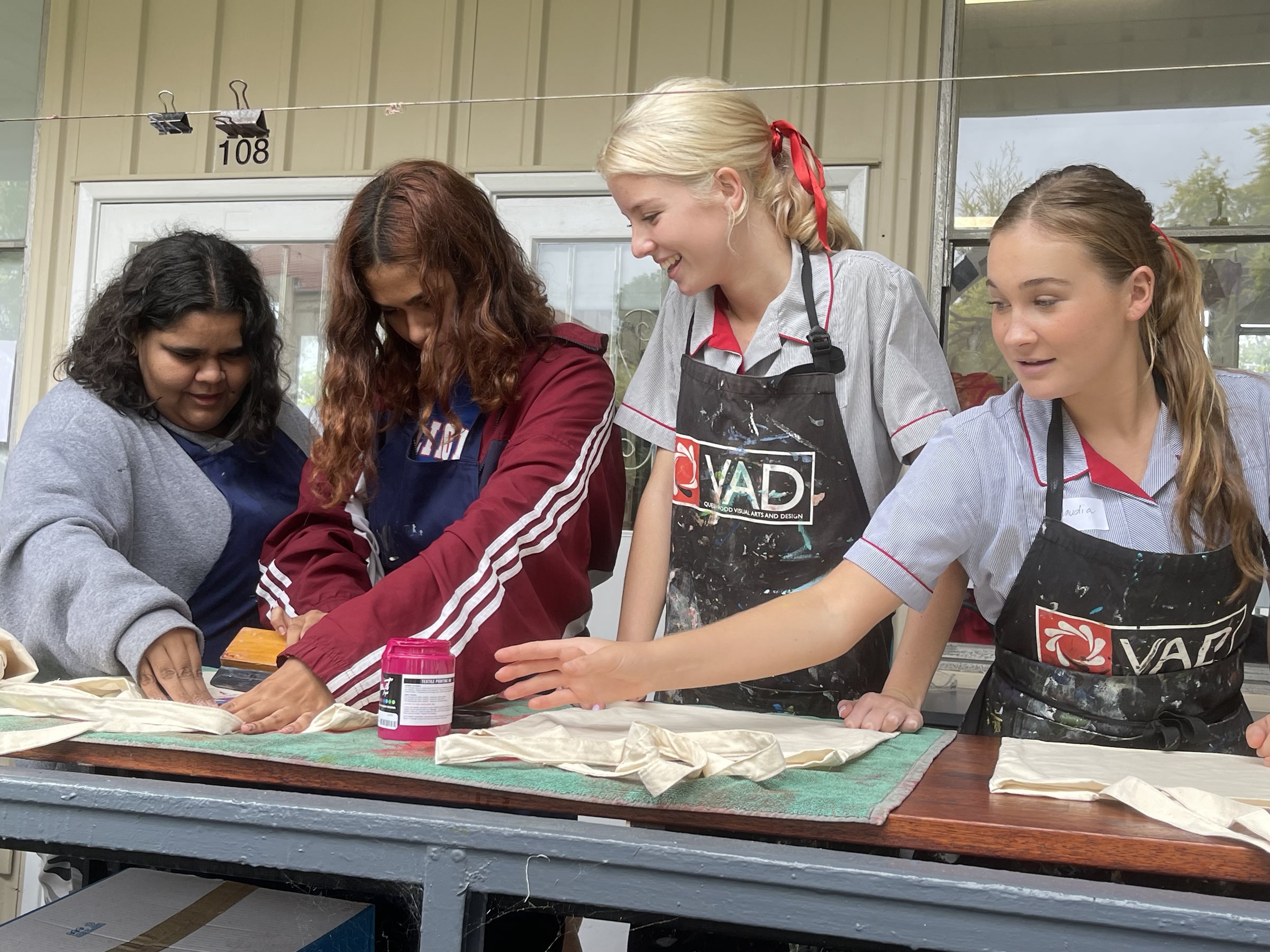
Commitment to service has always been at the heart of a Queenwood education.
Knowing Herself, Finding Her Voice
Cultivating Thoughtful, Courageous and Compassionate Changemakers

At Queenwood, character education lies at the heart of what it means to be educated.
Guided by our motto, per aspera ad astra, we believe character is shaped through challenge, reflection and purposeful action. Education is not only about achievement but also about human flourishing. Here, young women are given the intellectual and moral space to think, to question, and to become. We seek to graduate young women of depth, integrity and moral courage, prepared not only to succeed but also to lead with wisdom.
Character matters because flourishing communities depend on people of good character. It is not fixed, rather cultivated through values, habits and example, in partnership with families and communities. Queenwood cherishes virtue literacy, the capacity to reason ethically and act with integrity in complex situations, so that students learn not what to think, but how to think, and how to live well.
Drawing on the intellectual tradition of Socrates, Plato and Aristotle, and interpreted through a contemporary lens, our Character Education Strategy empowers students to become critical thinkers who value truth, principled leaders who act with courage, and changemakers who serve others with empathy and responsibility. This is a school where ideas matter, and where young women are encouraged to claim their own intellectual authority.
Truth – The Integrity of Mind
Students are challenged to think critically, question assumptions, and pursue truth with curiosity and intellectual humility.
Courage – The Strength to Lead
We cultivate resilience, ethical leadership and the confidence to act with principle, even when it is difficult.
Service – The Heart of Purpose
Learning is connected to real-world needs, inspiring compassionate action and sustained community engagement.
Character education is embedded in our student experience, curriculum, student care, co-curricular programs and service learning, and scaffolded through developmental stages from curiosity and belonging to purpose-driven leadership. Reflection transforms experience into wisdom, guided by phronesis – practical wisdom.
| Stage (Years) | Character Focus | Core Competencies |
|---|---|---|
| Foundation (K–2) |
Curiosity and belonging | Empathy, honesty, early ethical reasoning |
| Exploration (3–5) |
Independence and Responsibility | Decision-making, compassion, critical inquiry |
| Conviction (6–8) |
Identity and Integrity | Moral courage, resilience, questioning assumptions |
| Leadership (9–10) |
Influence and Innovation | Leadership, self–regulation, ethical communication |
| Purpose (11–12) |
Vision and Contribution | Purpose–driven action, reflection, moral clarity |
The Queenwood graduate is a critical thinker, ethical leader and changemaker. She meets challenge with clarity and strength, and is prepared not just for the future, but to shape it — with a mind of her own, and the courage to use it.

The role of the School Counsellor at Queenwood is to assist students in dealing with issues they may find difficult to manage on their own.
A member of the Student Care Team at Queenwood, our School Counsellor supports students from kindergarten through to Year 12.
Conversations are confidential, except where safety concerns or legal obligations require otherwise.
The School Counsellor works with students on a short- to medium-term basis and collaborates with families, teachers, and external mental health professionals to ensure each student is well supported at school.
If you would like to access counselling support, please speak with the year co-ordinator (years 7-12) or class teacher (years K-6).
Please note that emails are only monitored during school hours.

Peer support relationships offer opportunities for growth for all students.
At key moments, particularly at times of transition, students may benefit from additional support. The guidance, example and perspective of their peers can be a powerful source of encouragement, helping students build confidence, character and a sense of belonging.
These relationships are reciprocal. Older students develop patience, empathy and maturity through working with younger peers, while younger students are supported to grow in confidence and independence. Peer support networks, both formal and informal, contribute to a strong and inclusive culture across Queenwood, one in which individuals and the whole community can flourish.
In the Junior School, students in Years 5 and 6 are paired with a buddy in Kindergarten or Year 1. They spend time together through shared activities such as reading, play and conversation, building meaningful and lasting connections.
In the Senior School, Year 10 Peer Support leaders are trained to deliver a structured program for Year 7 students, designed to support their transition into secondary schooling. The program explores values, strengthens positive relationships and develops key social and emotional skills.
Older students may also support younger students on an individual basis. These connections may be shaped around shared interests, regular tutoring, or thoughtful conversations about learning, relationships and life at school.
Promoting and sustaining a supportive learning environment in which all students can expect to feel safe is fundamental to the flourishing of individuals and the community as a whole. At Queenwood, we understand that one student cannot truly flourish unless the conditions exist for all to flourish.
Students have a fundamental right to learn in an environment that is physically and emotionally safe, supportive and grounded in mutual respect. When safety and wellbeing are shared commitments, they become the foundation for growth, belonging and purpose.
The framework referenced below articulates a shared vision for physical and emotional safety and wellbeing at Queenwood, recognising that collective responsibility and care enable every student to learn, to grow in character and to flourish.